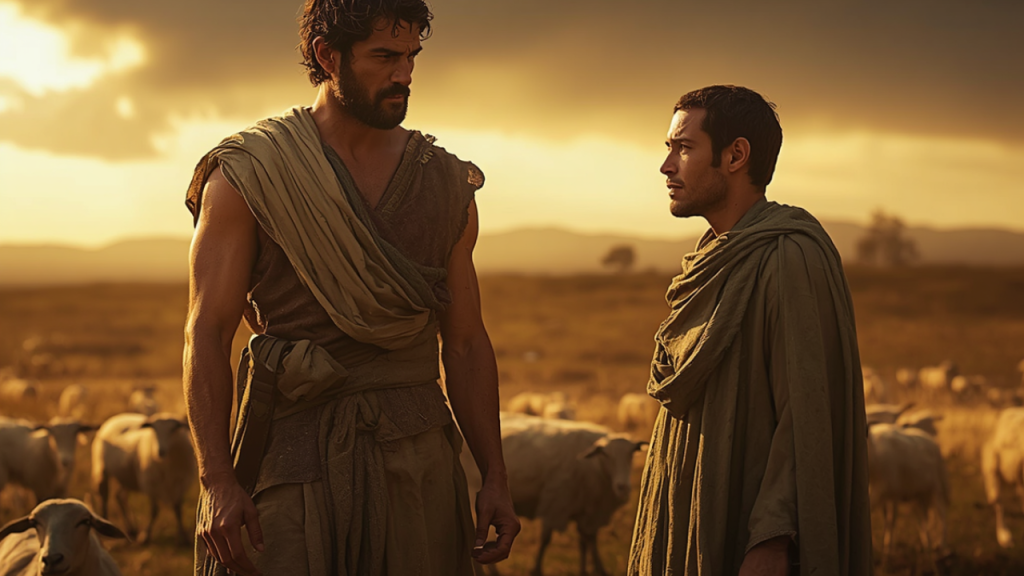
Genesis 4:1–2
“And Adam knew Eve his wife; and she conceived, and bare Cain, and said, I have gotten a man from the LORD.
And she again bare his brother Abel. And Abel was a keeper of sheep, but Cain was a tiller of the ground.” (KJV)
Plain Meaning
Adam and Eve begin life outside the garden, and Eve gives birth to Cain. She recognizes that this child has come from the LORD. Then she bears Abel, Cain’s brother. Abel becomes a keeper of sheep, while Cain becomes a tiller of the ground. The first family now begins to grow, and the first two brothers are introduced with different kinds of work.
Toolbox Notes
- Clause Map: Adam knew Eve his wife → she conceived → bare Cain → said, I have gotten a man from the LORD → she again bare Abel → Abel was a keeper of sheep → Cain was a tiller of the ground.
- Key Word – “Knew” (yādaʿ): to know; often used for intimate marital union between husband and wife.
- Key Word – “Conceived” (hārâ): to become pregnant, conceive a child.
- Key Word – “Bare” (yālaḏ): to bear, bring forth, give birth.
- Key Word – “Cain” (Qayin): connected with the idea of getting, acquiring, or possessing.
- Key Word – “Gotten” (qānâ): to get, acquire, possess, obtain.
- Key Word – “Abel” (Heḇel): vapor, breath, vanity, something passing or brief.
- Key Word – “Keeper” (rāʿâ): to shepherd, pasture, feed, tend.
- Key Word – “Sheep” (ṣōʾn): flock, sheep, small livestock.
- Key Word – “Tiller” (ʿāḇaḏ): to work, serve, labor, cultivate.
- Key Phrase – “From the LORD”: Eve recognizes the LORD as the giver of life.
- Key Phrase – “His brother Abel”: The account begins to focus on the relationship between the two brothers.
- Key Phrase – “Keeper of sheep”: Abel’s work involved tending and caring for flocks.
- Key Phrase – “Tiller of the ground”: Cain’s work involved cultivating the soil, the same ground cursed after Adam’s sin.
Digging Deeper
- Life continues after Eden because God is merciful.
- Eve gives birth in a fallen world, but children still come as a gift from the LORD.
- Cain’s name is tied to getting or acquiring, and Eve sees his birth as something received from God.
- Abel’s name carries the idea of breath or vapor, which quietly fits the shortness of his life in the account.
- Both brothers have real work, showing that labor continues outside the garden.
- Abel works with sheep, while Cain works the ground.
- The ground that Cain tills is the same ground God cursed because of Adam’s sin.
Doctrine in Work Boots
- God preserves human life after the fall.
- Children are gifts from the LORD.
- Marriage and family continue outside Eden by God’s mercy.
- Work remains part of man’s life after sin enters the world.
- Different callings and labors can both be honorable before God.
- Life outside Eden still depends completely on the LORD’s provision.
Battle Station (Objection & Answer)
Objection: “If Adam and Eve sinned, why did God still allow them to have children and continue life?”
Answer:
- God’s judgment was real, but His mercy was also real.
- God had already promised the seed of the woman in Genesis 3:15.
- Life continues because God is preserving the line through which His promise will move forward.
- The birth of children after the fall shows that sin did not cancel God’s purpose or mercy.
Life on the Job
- Exhortation (Do this): Receive your family, work, and daily life as gifts under the mercy of God.
- Comfort (Trust this): Even outside Eden, God still gives life, children, labor, and purpose.
- Warning (Avoid this): Do not assume ordinary life is automatic; every breath, birth, and job continues by God’s mercy.
Speak It Back (60-sec Summary)
“Adam knew Eve his wife, and she conceived and gave birth to Cain, saying she had gotten a man from the LORD. Then she bore Abel, Cain’s brother. Abel became a keeper of sheep, and Cain became a tiller of the ground. Genesis 4:1–2 shows that life, family, and work continue outside Eden by the mercy of God.”
Prayer Line
“Lord, help me see life, family, and work as gifts from Your hand, even in a fallen world.”
Memory & Drill (Flashcards)
- Q: Who did Adam know as his wife?
A: Eve. - Q: Who was the first son mentioned in Genesis 4?
A: Cain. - Q: What did Eve say when Cain was born?
A: “I have gotten a man from the LORD.” - Q: Who was Cain’s brother?
A: Abel. - Q: What kind of work did Abel do?
A: He was a keeper of sheep. - Q: What kind of work did Cain do?
A: He was a tiller of the ground. - Q: What doctrine does this passage teach?
A: God preserves life, family, and work after the fall. - Q: What practical comfort flows from this passage?
A: Even outside Eden, God still gives life and purpose.
Genesis 4:3–5
“And in process of time it came to pass, that Cain brought of the fruit of the ground an offering unto the LORD.
And Abel, he also brought of the firstlings of his flock and of the fat thereof. And the LORD had respect unto Abel and to his offering:
But unto Cain and to his offering he had not respect. And Cain was very wroth, and his countenance fell.” (KJV)
Plain Meaning
After some time passed, Cain and Abel both brought offerings unto the LORD. Cain brought fruit from the ground, while Abel brought the firstlings of his flock and the fat thereof. The LORD respected Abel and his offering, but He did not respect Cain and his offering. Cain became very angry, and his face showed it.
Toolbox Notes
- Clause Map: In process of time → Cain brought fruit of the ground → an offering unto the LORD → Abel also brought firstlings of his flock → and the fat thereof → the LORD had respect unto Abel and his offering → but not unto Cain and his offering → Cain was very wroth → his countenance fell.
- Key Word – “Process of time”: A passing of days or season; the account moves forward to a time of worship and offering.
- Key Word – “Brought” (bôʾ): to bring, come with, present, carry in.
- Key Word – “Offering” (minḥâ): gift, tribute, present, offering brought before another.
- Key Word – “Fruit” (pĕrî): produce, fruit, outcome, what comes forth from the ground.
- Key Word – “Firstlings” (bĕḵôrâ): firstborn, first offspring, chief or earliest of the flock.
- Key Word – “Fat” (ḥēleḇ): the rich or choice portion, often connected with the best part.
- Key Word – “Respect” (šāʿâ): to look upon, regard, pay attention to, accept.
- Key Word – “Wroth” (ḥārâ): to burn with anger, become hot, be kindled with wrath.
- Key Word – “Countenance” (pānîm): face, presence, expression.
- Key Phrase – “Unto the LORD”: The offerings were acts of worship directed toward God.
- Key Phrase – “Firstlings of his flock and of the fat thereof”: Abel brings the first and best.
- Key Phrase – “Had respect unto Abel and to his offering”: God looked with approval upon Abel and what he brought.
- Key Phrase – “Unto Cain and to his offering he had not respect”: God rejected Cain and his offering.
- Key Phrase – “His countenance fell”: Cain’s anger and inward condition showed on his face.
Digging Deeper
- Cain and Abel both come before the LORD with offerings, but God does not receive both the same way.
- The issue is not only the offering, but the worshiper; the text says God respected Abel and his offering, but not Cain and his offering.
- Abel brings the firstlings and the fat, showing honor, faith, and the giving of the best.
- Cain brings from the fruit of the ground, but the text does not say he brought the first or the best.
- God is not obligated to accept worship that is careless, faithless, or offered on man’s terms.
- Cain’s anger shows that his heart was not humble before God.
- Rejected worship reveals the heart: Abel responds by faith, but Cain responds with wrath.
Doctrine in Work Boots
- God cares about both the worship and the worshiper.
- True worship must be brought by faith, not merely by religious action.
- God is worthy of the first and best, not leftovers or casual offerings.
- God has the right to accept or reject worship.
- Anger at correction reveals pride in the heart.
- A fallen countenance often reveals an inward rebellion before it becomes outward sin.
Battle Station (Objection & Answer)
Objection: “Was God unfair to reject Cain’s offering?”
Answer:
- God is never unfair in His judgment.
- The text shows a difference between Abel and Cain, not only between their offerings.
- Abel brought the firstlings and the fat, showing honor and faith.
- Cain’s angry response shows that his heart was not right before God.
- The problem was not that Cain worked the ground, but that his worship was not accepted by the LORD.
Life on the Job
- Exhortation (Do this): Bring God your first and best, not your leftovers, excuses, or careless worship.
- Comfort (Trust this): God sees the heart behind the offering, not just the outward action.
- Warning (Avoid this): Do not get angry at God when He exposes what is wrong in your worship.
Speak It Back (60-sec Summary)
“Cain brought an offering from the fruit of the ground, and Abel brought the firstlings of his flock and the fat thereof. The LORD respected Abel and his offering, but He did not respect Cain and his offering. Cain became very angry, and his countenance fell. Genesis 4:3–5 shows that God cares about the worshiper and the offering, and that rejected worship can reveal pride and anger in the heart.”
Prayer Line
“Lord, teach me to bring You worship by faith, with a humble heart, giving You the first and best.”
Memory & Drill (Flashcards)
- Q: What did Cain bring to the LORD?
A: The fruit of the ground. - Q: What did Abel bring to the LORD?
A: The firstlings of his flock and the fat thereof. - Q: Which offering did the LORD respect?
A: Abel and his offering. - Q: Which offering did the LORD not respect?
A: Cain and his offering. - Q: How did Cain respond?
A: He was very wroth. - Q: What happened to Cain’s countenance?
A: It fell. - Q: What doctrine does this passage teach?
A: God cares about both the worship and the worshiper. - Q: What practical warning flows from this passage?
A: Do not offer careless worship and then become angry when God exposes the heart.
Genesis 4:6–7
“And the LORD said unto Cain, Why art thou wroth? and why is thy countenance fallen?
If thou doest well, shalt thou not be accepted? and if thou doest not well, sin lieth at the door. And unto thee shall be his desire, and thou shalt rule over him.” (KJV)
Plain Meaning
The LORD speaks directly to Cain after his anger rises. God asks why Cain is angry and why his face has fallen. Then God warns him that if he does well, he will be accepted, but if he does not do well, sin is lying at the door like a threat ready to rule him. Cain must master sin before sin masters him.
Toolbox Notes
- Clause Map: The LORD said unto Cain → why art thou wroth → why is thy countenance fallen → if thou doest well → shalt thou not be accepted → if thou doest not well → sin lieth at the door → unto thee shall be his desire → thou shalt rule over him.
- Key Word – “Wroth” (ḥārâ): to burn with anger, be kindled, grow hot with wrath.
- Key Word – “Countenance” (pānîm): face, expression, presence, outward appearance.
- Key Word – “Doest well” (yāṭaḇ): to do good, do right, act rightly, be pleasing.
- Key Word – “Accepted” (śĕʾēṯ): lifting up, acceptance, exaltation, being received.
- Key Word – “Sin” (ḥaṭṭāʾṯ): sin, offense, missing the mark, guilt before God.
- Key Word – “Lieth” (rāḇaṣ): to crouch, lie down, rest like an animal waiting.
- Key Word – “Desire” (tĕšûqâ): longing, desire, impulse, turning toward.
- Key Word – “Rule” (māšal): to rule, govern, master, have dominion over.
- Key Phrase – “Why art thou wroth?”: God confronts Cain’s anger before it becomes murder.
- Key Phrase – “If thou doest well”: Cain is called to repentance and right action.
- Key Phrase – “Sin lieth at the door”: Sin is pictured like a crouching beast ready to attack.
- Key Phrase – “Unto thee shall be his desire”: Sin desires to control and dominate Cain.
- Key Phrase – “Thou shalt rule over him”: Cain must master sin instead of yielding to it.
Digging Deeper
- God confronts Cain before Cain commits murder, showing mercy in warning.
- Cain’s fallen countenance reveals that anger has already taken root in his heart.
- God does not treat Cain as hopeless; He calls him to do well.
- Sin is pictured as active, dangerous, and close at hand.
- The doorway image shows how near temptation is when anger is not dealt with.
- Cain is warned that sin wants to rule him.
- This verse shows that unchecked anger can become a doorway to greater sin.
Doctrine in Work Boots
- God warns sinners before judgment falls.
- Anger in the heart must be confronted before it becomes outward sin.
- Sin is not passive; it seeks to rule and dominate.
- Man is responsible to resist sin and do what is right before God.
- God calls Cain to repentance instead of immediately destroying him.
- Sin must be mastered, or it will master the sinner.
Battle Station (Objection & Answer)
Objection: “If Cain was already angry, was he unable to stop what came next?”
Answer:
- God’s warning shows that Cain was responsible for what he would do next.
- Cain’s anger was real, but it did not force him to murder.
- God told him sin was at the door, meaning danger was near but not yet completed.
- Cain was commanded to rule over sin instead of surrendering to it.
Life on the Job
- Exhortation (Do this): Deal with anger early before it opens the door to worse sin.
- Comfort (Trust this): God warns before destruction; His correction is mercy.
- Warning (Avoid this): Do not let bitterness crouch at the door of your heart until it rules you.
Speak It Back (60-sec Summary)
“God asks Cain why he is angry and why his countenance has fallen. He tells Cain that if he does well, he will be accepted, but if he does not do well, sin lies at the door. Sin desires to rule him, but Cain must rule over it. Genesis 4:6–7 shows that God mercifully warns Cain before murder happens, and that sin must be mastered before it masters the man.”
Prayer Line
“Lord, expose my anger early and give me strength to rule over sin before it rules over me.”
Memory & Drill (Flashcards)
- Q: Who speaks to Cain in Genesis 4:6–7?
A: The LORD. - Q: What does God ask Cain?
A: Why he is wroth and why his countenance is fallen. - Q: What does God say will happen if Cain does well?
A: He will be accepted. - Q: Where does God say sin is lying?
A: At the door. - Q: What does sin desire to do?
A: Rule over Cain. - Q: What must Cain do instead?
A: Rule over sin. - Q: What doctrine does this passage teach?
A: Sin seeks to rule man, but man is responsible to resist it. - Q: What practical warning flows from this passage?
A: Deal with anger before it opens the door to greater sin.
Genesis 4:8
“And Cain talked with Abel his brother: and it came to pass, when they were in the field, that Cain rose up against Abel his brother, and slew him.” (KJV)
Plain Meaning
Cain speaks with Abel his brother, and when they are in the field, Cain rises up against him and kills him. The anger God warned Cain about now becomes action. Sin that was crouching at the door has now ruled over Cain, leading to the first murder in Scripture.
Toolbox Notes
- Clause Map: Cain talked with Abel his brother → it came to pass → when they were in the field → Cain rose up against Abel his brother → and slew him.
- Key Word – “Brother” (ʾāḥ): brother, relative, close kin.
- Key Word – “Rose up” (qûm): to rise, stand up, arise against.
- Key Word – “Against”: shows hostility, opposition, and attack.
- Key Word – “Slew” (hāraḡ): to kill, slay, murder, strike down.
- Key Phrase – “Abel his brother”: The word brother is repeated, emphasizing the horror of the sin.
- Key Phrase – “In the field”: The place of Cain’s work becomes the place of murder.
- Key Phrase – “Rose up against”: Cain moves from inward anger to outward violence.
- Key Phrase – “Slew him”: Sin has fully broken out into death.
Digging Deeper
- Cain ignores God’s warning and lets sin rule him.
- The first recorded death of a man is murder by his own brother.
- The repeated phrase “his brother” makes Cain’s crime feel heavier.
- Sin does not stay private; it grows and harms others.
- Cain’s anger at God’s rejection becomes violence against Abel.
- The field, connected with Cain’s labor, becomes the scene of bloodshed.
- This verse shows how worship problems, heart anger, and jealousy can lead to deadly action.
Doctrine in Work Boots
- Sin grows when it is not ruled over.
- Anger and jealousy can become violence when left unchecked.
- Murder begins in the heart before it happens by the hand.
- Sin destroys family, brotherhood, and human life.
- Ignoring God’s warning leads to greater judgment.
- Human life is precious, and shedding innocent blood is wicked before God.
Battle Station (Objection & Answer)
Objection: “Was Cain’s murder just a moment of anger?”
Answer:
- Cain’s anger had already been exposed by God before the murder happened.
- God warned Cain that sin was lying at the door.
- Cain had time to turn, but he chose to rise up against his brother.
- The murder was not random; it was the fruit of anger, jealousy, and rebellion left unchecked.
Life on the Job
- Exhortation (Do this): Deal with jealousy and anger before they grow into words, actions, and destruction.
- Comfort (Trust this): God sees innocent blood and will not ignore hidden violence or injustice.
- Warning (Avoid this): Do not think sin will stay small if you refuse to rule over it.
Speak It Back (60-sec Summary)
“Cain talked with Abel his brother, and when they were in the field, Cain rose up against him and killed him. Genesis 4:8 shows that Cain ignored God’s warning, let sin rule him, and committed the first murder. Anger, jealousy, and rejected worship grew into violence against his own brother.”
Prayer Line
“Lord, help me kill anger and jealousy in my heart before they turn into destructive words or actions.”
Memory & Drill (Flashcards)
- Q: Who did Cain talk with?
A: Abel his brother. - Q: Where were Cain and Abel when the murder happened?
A: In the field. - Q: What did Cain do to Abel?
A: He slew him. - Q: What warning had Cain ignored?
A: That sin was lying at the door and desired to rule him. - Q: What does the repeated phrase “his brother” emphasize?
A: The horror of Cain murdering his own brother. - Q: What doctrine does this passage teach?
A: Sin grows into destruction when it is not ruled over. - Q: What practical warning flows from this passage?
A: Do not let anger and jealousy remain in the heart until they become destructive action.
Genesis 4:9
“And the LORD said unto Cain, Where is Abel thy brother? And he said, I know not: Am I my brother’s keeper?” (KJV)
Plain Meaning
After Cain kills Abel, the LORD questions him. God asks where Abel his brother is, not because God lacks knowledge, but to confront Cain and draw out the truth. Cain lies by saying he does not know, then answers with a hard and careless question: “Am I my brother’s keeper?”
Toolbox Notes
- Clause Map: The LORD said unto Cain → Where is Abel thy brother → Cain said → I know not → Am I my brother’s keeper?
- Key Word – “LORD” (YHWH): the covenant name of God, the self-existent and faithful God.
- Key Word – “Cain” (Qayin): connected with getting or acquiring; the firstborn son of Adam and Eve.
- Key Word – “Abel” (Heḇel): breath, vapor, vanity; Cain’s brother who was slain.
- Key Word – “Know” (yādaʿ): to know, perceive, recognize, understand.
- Key Word – “Keeper” (šāmar): to guard, keep, watch over, preserve.
- Key Phrase – “Where is Abel thy brother?”: God confronts Cain with his responsibility toward Abel.
- Key Phrase – “I know not”: Cain lies to God after murdering his brother.
- Key Phrase – “Am I my brother’s keeper?”: Cain rejects responsibility and shows a hardened heart.
Digging Deeper
- God questions Cain just as He questioned Adam after sin.
- God is not asking for information; He is calling Cain into accountability.
- Cain’s sin moves from anger, to murder, to lying, to defiance.
- The word “brother” again keeps the horror of the crime in front of Cain.
- Cain does not show sorrow over Abel’s death.
- Cain’s answer reveals a cold heart toward both God and his brother.
- The first murderer is also shown as a liar before God.
Doctrine in Work Boots
- God sees hidden sin and calls sinners into account.
- Murder does not end with violence; sin often adds lies to cover guilt.
- Man is responsible before God for how he treats his brother.
- A hardened heart speaks carelessly even after serious sin.
- God’s questions expose guilt, not because He lacks knowledge, but because man must answer.
- Sin damages man’s relationship with God and with his neighbor.
Battle Station (Objection & Answer)
Objection: “Was Cain really responsible for Abel after all?”
Answer:
- Cain was not innocent concerning Abel; he had just murdered him.
- His question was not honest confusion, but defiant evasion.
- God’s wording, “thy brother,” shows Cain had responsibility toward him.
- Scripture teaches that man is accountable for how he treats his neighbor, especially his own brother.
Life on the Job
- Exhortation (Do this): Take responsibility for how you treat the people God has placed near you.
- Comfort (Trust this): God sees hidden wrongs, even when victims cannot speak for themselves.
- Warning (Avoid this): Do not answer conviction with sarcasm, lies, or hardened excuses.
Speak It Back (60-sec Summary)
“The LORD asked Cain, ‘Where is Abel thy brother?’ Cain lied and said he did not know, then asked, ‘Am I my brother’s keeper?’ Genesis 4:9 shows Cain’s sin growing worse: after anger and murder, he now lies to God and rejects responsibility for his brother. God’s question exposes Cain’s guilt and calls him into account.”
Prayer Line
“Lord, keep my heart tender before You, and teach me to take responsibility for how I treat others.”
Memory & Drill (Flashcards)
- Q: What did the LORD ask Cain?
A: “Where is Abel thy brother?” - Q: Did God ask because He did not know where Abel was?
A: No. - Q: What did Cain answer?
A: “I know not.” - Q: What question did Cain ask God?
A: “Am I my brother’s keeper?” - Q: What does “keeper” mean?
A: One who guards, watches, or preserves. - Q: What sin did Cain add after murder?
A: Lying and defiance. - Q: What doctrine does this passage teach?
A: God sees hidden sin and holds man accountable for his brother. - Q: What practical warning flows from this passage?
A: Do not answer God’s conviction with lies, sarcasm, or excuses.
Genesis 4:10–11
“And he said, What hast thou done? the voice of thy brother’s blood crieth unto me from the ground.
And now art thou cursed from the earth, which hath opened her mouth to receive thy brother’s blood from thy hand;” (KJV)
Plain Meaning
God confronts Cain directly and asks what he has done. Abel’s blood is pictured as crying out to God from the ground. Cain may have tried to hide the murder, but the blood speaks before the LORD. Because Cain shed his brother’s blood, God now pronounces a curse upon him from the earth that received Abel’s blood from his hand.
Toolbox Notes
- Clause Map: God said → what hast thou done → the voice of thy brother’s blood → crieth unto me → from the ground → now art thou cursed → from the earth → which opened her mouth → to receive thy brother’s blood → from thy hand.
- Key Word – “Done” (ʿāśâ): to do, make, perform, carry out.
- Key Word – “Voice” (qôl): sound, cry, voice, proclamation..
- Key Word – “Crieth” (ṣāʿaq): to cry out, call for help, shout in distress.
- Key Word – “Ground” (ʾăḏāmâ): soil, earth, land; the ground from which man was taken and which now receives blood.
- Key Word – “Cursed” (ʾārar): placed under judgment, bound under divine sentence.
- Key Phrase – “What hast thou done?”: God confronts the seriousness of Cain’s sin.
- Key Phrase – “Thy brother’s blood”: God keeps the family betrayal and murder in view.
- Key Phrase – “Crieth unto me”: Innocent blood has a voice before God.
- Key Phrase – “From the ground”: The place of Cain’s work has become the witness against him.
- Key Phrase – “Cursed from the earth”: Cain’s relationship to the ground is now judged because of Abel’s blood.
- Key Phrase – “From thy hand”: Cain is personally responsible for the bloodshed.
Digging Deeper
- God’s question exposes the horror of Cain’s sin.
- Abel is dead, but his blood still cries out before God.
- Cain’s hidden murder is not hidden from the LORD.
- The ground, already cursed because of Adam’s sin, now receives Abel’s blood.
- Cain had been a tiller of the ground, but now the ground becomes part of his judgment.
- Innocent blood is not silent before God, even when the victim cannot speak on earth.
- Cain is the first man in Scripture directly called cursed.
Doctrine in Work Boots
- God sees and hears innocent blood.
- Murder is not merely an offense against man, but a sin that cries out before God.
- Hidden sin is never hidden from the LORD.
- God holds the sinner personally responsible for bloodshed.
- The earth itself bears witness against human violence.
- Sin brings judgment into the very place where man works and lives.
Battle Station (Objection & Answer)
Objection: “How can blood cry out if Abel was already dead?”
Answer:
- The language shows that Abel’s blood stands as a witness before God.
- Though Abel’s earthly voice was silenced, his blood still testifies to the injustice done.
- God is showing that murder cannot erase accountability.
- The victim may be dead, but the crime still speaks before the LORD.
Life on the Job
- Exhortation (Do this): Take human life seriously and remember that God sees how people are treated.
- Comfort (Trust this): God hears the cries that men try to silence.
- Warning (Avoid this): Do not think hidden sin is buried just because no man saw it.
Speak It Back (60-sec Summary)
“God asks Cain, ‘What hast thou done?’ and says Abel’s blood cries out from the ground. Cain may have silenced Abel’s voice, but he could not silence Abel’s blood before God. Genesis 4:10–11 shows that innocent blood has a voice, hidden sin is seen by the LORD, and Cain is cursed from the earth because his brother’s blood came from his hand.”
Prayer Line
“Lord, keep my hands clean from harm, my heart free from violence, and my life open before You.”
Memory & Drill (Flashcards)
- Q: What did God ask Cain in Genesis 4:10?
A: “What hast thou done?” - Q: What was crying out to God?
A: The voice of Abel’s blood. - Q: Where did Abel’s blood cry from?
A: From the ground. - Q: What does Abel’s blood show before God?
A: The witness of innocent blood and Cain’s guilt. - Q: What does God pronounce over Cain?
A: A curse from the earth. - Q: What had the earth opened her mouth to receive?
A: Abel’s blood. - Q: From whose hand did Abel’s blood come?
A: Cain’s hand. - Q: What doctrine does this passage teach?
A: God sees hidden bloodshed and holds sinners accountable. - Q: What practical comfort flows from this passage?
A: God hears the cries that men try to silence.
Genesis 4:12
“When thou tillest the ground, it shall not henceforth yield unto thee her strength; a fugitive and a vagabond shalt thou be in the earth.” (KJV)
Plain Meaning
God continues Cain’s judgment. Since Cain had shed his brother’s blood into the ground, the ground would no longer yield its strength to him. Cain, who had been a tiller of the ground, would now lose stability in the very work he once had. He would become a fugitive and a vagabond, wandering in the earth without settled rest.
Toolbox Notes
- Clause Map: When thou tillest the ground → it shall not henceforth yield unto thee her strength → a fugitive and a vagabond → shalt thou be in the earth.
- Key Word – “Tillest” (ʿāḇaḏ): to work, serve, labor, cultivate.
- Key Word – “Yield” (nāṯan): to give, provide, grant, deliver.
- Key Word – “Strength” (kōaḥ): power, ability, produce, productive force.
- Key Word – “Fugitive” (nûaʿ): one who wanders, shakes, staggers, moves restlessly.
- Key Word – “Vagabond” (nûḏ): wanderer, one driven about, one without settled place.
- Key Phrase – “When thou tillest the ground”: Cain’s judgment touches his work directly.
- Key Phrase – “Shall not henceforth yield”: The ground will no longer cooperate with Cain as before.
- Key Phrase – “Her strength”: The productive power of the soil will be withheld from him.
- Key Phrase – “A fugitive and a vagabond”: Cain will live under restlessness, instability, and exile.
Digging Deeper
- Cain’s punishment fits his sin: the ground that received Abel’s blood now resists Cain’s labor.
- Cain was a tiller of the ground, but his calling is now deeply frustrated by judgment.
- The fall had already made work hard, but Cain’s sin brings a personal judgment upon his labor.
- “Her strength” shows that the ground has productive power, but it will not freely yield it to Cain.
- Cain wanted to remove Abel, but now Cain himself is removed from settled life.
- Sin promises control, but it often produces restlessness and exile.
- Cain’s life becomes marked by wandering because he refused to rule over sin.
Doctrine in Work Boots
- Sin brings consequences into a man’s work and calling.
- God’s judgment is fitting and righteous.
- Violence against others can bring instability into the sinner’s own life.
- The earth is under God’s authority and can become part of His judgment.
- Sin does not produce peace; it produces restlessness, wandering, and loss.
- Refusing to rule over sin leads to being ruled by consequences.
Battle Station (Objection & Answer)
Objection: “Why would God punish Cain’s work if Cain’s sin was murder?”
Answer:
- Cain’s murder was connected to the ground because Abel’s blood was received into it.
- Cain was a tiller of the ground, so God’s judgment struck the place of his labor and identity.
- The punishment fits the crime: the ground that witnessed the bloodshed would no longer yield strength to Cain.
- God’s judgment shows that sin can corrupt and damage even the ordinary work of a man’s hands.
Life on the Job
- Exhortation (Do this): Keep your hands clean before God, because sin can bring trouble into your work and stability.
- Comfort (Trust this): God rules over the ground, the harvest, and the consequences men cannot control.
- Warning (Avoid this): Do not think sin will only affect your private life; it can follow you into your labor, home, and future.
Speak It Back (60-sec Summary)
“God tells Cain that when he tills the ground, it will no longer yield its strength to him. Cain, who was a tiller of the ground, will now become a fugitive and a vagabond in the earth. Genesis 4:12 shows that Cain’s murder brings judgment into his work, his stability, and his life. Sin does not give rest; it makes a man wander.”
Prayer Line
“Lord, keep my hands clean and my heart obedient, so I do not bring trouble into the work and life You have given me.”
Memory & Drill (Flashcards)
- Q: What work had Cain done?
A: He was a tiller of the ground. - Q: What would the ground no longer yield to Cain?
A: Her strength. - Q: What does “yield her strength” mean?
A: To give its productive power or produce. - Q: What would Cain become in the earth?
A: A fugitive and a vagabond. - Q: What does “fugitive” point to?
A: Restless wandering and instability. - Q: What does “vagabond” mean?
A: A wanderer without a settled place. - Q: What doctrine does this passage teach?
A: Sin brings consequences into a man’s work, stability, and future. - Q: What practical warning flows from this passage?
A: Do not think sin will stay private; it can follow you into your labor and life.
Genesis 4:13–14
“And Cain said unto the LORD, My punishment is greater than I can bear.
Behold, thou hast driven me out this day from the face of the earth; and from thy face shall I be hid; and I shall be a fugitive and a vagabond in the earth; and it shall come to pass, that every one that findeth me shall slay me.” (KJV)
Plain Meaning
Cain responds to God’s judgment by saying his punishment is more than he can bear. He understands that he is being driven from the ground, hidden from God’s face, and made a fugitive and vagabond in the earth. Cain also fears that anyone who finds him will kill him. His words show fear over the consequences, but not clear repentance over the sin.
Toolbox Notes
- Clause Map: Cain said unto the LORD → my punishment is greater than I can bear → thou hast driven me out → from the face of the earth → from thy face shall I be hid → I shall be a fugitive and a vagabond → every one that findeth me shall slay me.
- Key Word – “Punishment” (ʿāwōn): iniquity, guilt, punishment, consequence of sin.
- Key Word – “Greater” (gāḏôl): great, large, heavy, severe.
- Key Word – “Bear” (nāśāʾ): to lift, carry, bear, endure.
- Key Word – “Driven” (gāraš): to drive out, expel, cast away.
- Key Word – “Face” (pānîm): face, presence, favor, personal nearness.
- Key Word – “Hid” (sāṯar): to hide, conceal, be hidden.
- Key Word – “Fugitive” (nûaʿ): wanderer, one who shakes, staggers, or moves restlessly.
- Key Word – “Vagabond” (nûḏ): one who wanders, roams, or has no settled place.
- Key Word – “Slay” (hāraḡ): to kill, strike down, murder.
- Key Phrase – “Greater than I can bear”: Cain feels the weight of the consequence.
- Key Phrase – “From thy face shall I be hid”: Cain recognizes distance from God’s presence and favor.
- Key Phrase – “A fugitive and a vagabond”: Cain’s life will be marked by restless wandering.
- Key Phrase – “Every one that findeth me shall slay me”: Cain fears that violence will return upon him.
Digging Deeper
- Cain is distressed by punishment, but the text does not show him grieving over Abel’s blood.
- He is more concerned about what will happen to him than what he has done.
- Sin often fears consequences more than it hates guilt.
- Cain recognizes that being driven away from God’s face is a serious loss.
- The murderer now fears being murdered.
- Cain’s words show that judgment has made him afraid, but fear is not the same as repentance.
- His punishment touches land, work, home, safety, and nearness to God.
Doctrine in Work Boots
- Sin brings consequences heavier than man expects.
- Fear of punishment is not the same as repentance.
- Separation from God’s face is more serious than earthly loss.
- Violence produces fear, instability, and dread.
- God’s judgment exposes how powerless man is to carry the weight of sin.
- A guilty man may pity himself while still failing to mourn his sin.
Battle Station (Objection & Answer)
Objection: “Was Cain finally repenting when he said his punishment was greater than he could bear?”
Answer:
- Cain admits the punishment is heavy, but he does not clearly confess the evil of murdering Abel.
- His focus is mostly on what he will suffer, not on the brother he killed.
- Sorrow over consequences is not the same as sorrow over sin.
- True repentance grieves the offense against God, not only the pain that follows it.
Life on the Job
- Exhortation (Do this): Grieve the sin itself, not only the consequences that come after it.
- Comfort (Trust this): Even when consequences are heavy, God is still the One to whom sinners must speak.
- Warning (Avoid this): Do not confuse self-pity with repentance.
Speak It Back (60-sec Summary)
“Cain tells the LORD that his punishment is greater than he can bear. He fears being driven from the earth, hidden from God’s face, made a fugitive and vagabond, and killed by whoever finds him. Genesis 4:13–14 shows Cain feeling the weight of judgment, but not clearly repenting over Abel’s blood. He fears the consequences more than he mourns the sin.”
Prayer Line
“Lord, give me a heart that hates sin itself, not just the pain and consequences that follow it.”
Memory & Drill (Flashcards)
- Q: What did Cain say about his punishment?
A: It was greater than he could bear. - Q: What did Cain say God had done to him?
A: Driven him out from the face of the earth. - Q: What did Cain say would happen concerning God’s face?
A: “From thy face shall I be hid.” - Q: What would Cain be in the earth?
A: A fugitive and a vagabond. - Q: What did Cain fear others would do to him?
A: Slay him. - Q: Does Cain clearly repent in these verses?
A: No, he mainly fears the punishment and consequences. - Q: What doctrine does this passage teach?
A: Sin brings consequences heavier than man expects. - Q: What practical warning flows from this passage?
A: Do not confuse fear of consequences with true repentance.
Genesis 4:15
“And the LORD said unto him, Therefore whosoever slayeth Cain, vengeance shall be taken on him sevenfold. And the LORD set a mark upon Cain, lest any finding him should kill him.” (KJV)
Plain Meaning
The LORD answers Cain’s fear by placing protection over him. Though Cain is guilty and under judgment, God does not allow others to kill him freely. God warns that whoever slays Cain will face sevenfold vengeance. Then the LORD sets a mark upon Cain so that anyone who finds him will not kill him.
Toolbox Notes
- Clause Map: The LORD said unto him → whosoever slayeth Cain → vengeance shall be taken on him sevenfold → the LORD set a mark upon Cain → lest any finding him → should kill him.
- Key Word – “Slayeth” (hāraḡ): to kill, strike down, murder.
- Key Word – “Vengeance” (nāqam): punishment, retribution, avenging justice.
- Key Word – “Sevenfold” (šiḇʿāṯayim): seven times, full measure, complete or multiplied judgment.
- Key Word – “Set” (śûm): to place, appoint, put, establish.
- Key Word – “Mark” (ʾôṯ): sign, token, mark, signal.
- Key Word – “Finding” (māṣāʾ): to find, encounter, come upon.
- Key Phrase – “Whosoever slayeth Cain”: God forbids private revenge against Cain.
- Key Phrase – “Vengeance shall be taken on him sevenfold”: God reserves judgment and warns against further bloodshed.
- Key Phrase – “The LORD set a mark upon Cain”: God gives Cain a visible sign of protection.
- Key Phrase – “Lest any finding him should kill him”: The mark restrains others from taking Cain’s life.
Digging Deeper
- Cain deserves judgment, but God still shows restraint and mercy.
- God does not remove Cain’s punishment, but He limits further violence against him.
- The murderer is protected from murder, not because he is innocent, but because vengeance belongs to God.
- The mark of Cain is not described in detail, so Scripture does not tell us exactly what it looked like.
- The purpose of the mark was protection, not racial identity, curse symbolism, or anything later men have wrongly imagined.
- God’s warning of sevenfold vengeance shows that violence must not keep spreading without restraint.
- This verse shows God’s authority over justice, punishment, mercy, and human life.
Doctrine in Work Boots
- Vengeance belongs to God, not man.
- God can judge the guilty while still showing mercy.
- Human life remains under God’s authority, even the life of a guilty man.
- God restrains violence so bloodshed does not multiply without limit.
- The mark of Cain was a sign of protection, not permission to sin.
- God’s justice is measured, holy, and not driven by human revenge.
Battle Station (Objection & Answer)
Objection: “Why would God protect Cain after he murdered Abel?”
Answer:
- God had already judged Cain with exile, restlessness, and loss from the ground.
- Protecting Cain did not mean excusing his murder.
- God was stopping others from taking vengeance into their own hands.
- If every man answered violence with more violence, bloodshed would spread even further.
- God showed that justice belongs to Him, not to uncontrolled human revenge.
Life on the Job
- Exhortation (Do this): Leave vengeance in God’s hands and do not repay evil with evil.
- Comfort (Trust this): God can handle justice better than man’s anger ever could.
- Warning (Avoid this): Do not confuse God’s mercy toward the guilty with approval of their sin.
Speak It Back (60-sec Summary)
“God tells Cain that whoever kills him will face sevenfold vengeance, and the LORD sets a mark on Cain so that no one who finds him will kill him. Genesis 4:15 shows that God judged Cain but also restrained further violence. Cain was not innocent, but vengeance belonged to God, not to men seeking revenge.”
Prayer Line
“Lord, teach me to trust Your justice and leave vengeance in Your hands.”
Memory & Drill (Flashcards)
- Q: What did God say would happen to whoever killed Cain?
A: Vengeance would be taken on him sevenfold. - Q: What did the LORD set upon Cain?
A: A mark. - Q: Why did God set a mark upon Cain?
A: So that anyone finding him would not kill him. - Q: Did God’s protection mean Cain was innocent?
A: No. - Q: What does “sevenfold” point to?
A: A full, multiplied, or complete measure of vengeance. - Q: Who has the right to vengeance?
A: God. - Q: What doctrine does this passage teach?
A: Vengeance belongs to God, and He restrains human violence. - Q: What practical warning flows from this passage?
A: Do not confuse God’s mercy toward the guilty with approval of their sin.
Genesis 4:16–18
“And Cain went out from the presence of the LORD, and dwelt in the land of Nod, on the east of Eden.
And Cain knew his wife; and she conceived, and bare Enoch: and he builded a city, and called the name of the city, after the name of his son, Enoch.
And unto Enoch was born Irad: and Irad begat Mehujael: and Mehujael begat Methusael: and Methusael begat Lamech.” (KJV)
Plain Meaning
Cain leaves the presence of the LORD and settles in the land of Nod, east of Eden. He has a wife, and she bears a son named Enoch. Cain then builds a city and names it after his son. The passage then traces Cain’s family line from Enoch to Irad, Mehujael, Methusael, and Lamech.
Toolbox Notes
- Clause Map: Cain went out → from the presence of the LORD → dwelt in the land of Nod → east of Eden → Cain knew his wife → she conceived → bare Enoch → Cain builded a city → called the city after Enoch → Enoch begat Irad → Irad begat Mehujael → Mehujael begat Methusael → Methusael begat Lamech.
- Key Word – “Went out” (yāṣāʾ): to go out, depart, come forth, leave.
- Key Word – “Presence” (pānîm): face, presence, nearness, favor.
- Key Word – “Dwelt” (yāšaḇ): to sit, remain, settle, inhabit.
- Key Word – “Nod” (Nôḏ): wandering; connected to Cain’s judgment as a fugitive and vagabond.
- Key Word – “East” (qeḏem): eastward, toward the east, direction away from Eden.
- Key Word – “Knew” (yādaʿ): to know; often used for intimate marital union between husband and wife.
- Key Word – “Conceived” (hārâ): to become pregnant, conceive a child.
- Key Word – “Bare” (yālaḏ): to bear, bring forth, give birth.
- Key Word – “Builded” (bānâ): to build, construct, establish.
- Key Word – “City” (ʿîr): city, town, inhabited settlement.
- Key Phrase – “From the presence of the LORD”: Cain moves farther from fellowship and favor with God.
- Key Phrase – “Land of Nod”: Cain lives in a place marked by wandering.
- Key Phrase – “East of Eden”: Movement eastward continues the picture of distance from the garden.
- Key Phrase – “Builded a city”: Cain seeks settlement, security, and legacy despite being judged as a wanderer.
- Key Phrase – “After the name of his son”: Cain names the city after Enoch, tying his legacy to his family line.
Digging Deeper
- Cain leaves the presence of the LORD, showing spiritual distance as well as physical exile.
- The land of Nod fits Cain’s judgment as a restless wanderer.
- Cain is still alive, marrying, having children, and building, showing that God’s mercy still allows life to continue.
- Cain builds a city, which may show his desire for security, permanence, and legacy.
- The city is named after his son, showing the beginning of human culture and family identity outside Eden.
- The line of Cain continues, but the account will later show that human progress without godliness does not heal the heart.
- These verses begin tracing a civilization that can build, multiply, and advance while still being far from the LORD.
Doctrine in Work Boots
- Sin drives man away from the presence and favor of God.
- Life can continue under mercy even after judgment.
- Human culture can develop outside Eden, but culture cannot replace fellowship with God.
- Man often seeks security and legacy when he is restless before God.
- Family lines matter because Scripture traces the spread of sin and the promise of redemption through generations.
- Building a city does not fix a heart that is far from the LORD.
Battle Station (Objection & Answer)
Objection: “Where did Cain get his wife?”
Answer:
- Genesis 5:4 says Adam had sons and daughters.
- Cain’s wife would have come from Adam and Eve’s wider family line.
- Early human history began from one family, so marriages happened within that first human line.
- The focus of Genesis 4 is not on naming every child, but on tracing Cain’s line and the growth of life outside Eden.
Life on the Job
- Exhortation (Do this): Do not try to build a name, home, or future while ignoring your need for God’s presence.
- Comfort (Trust this): Even in a fallen world, God still allows families, work, building, and life to continue.
- Warning (Avoid this): Do not mistake outward progress for spiritual health.
Speak It Back (60-sec Summary)
“Cain went out from the presence of the LORD and lived in the land of Nod, east of Eden. He had a son named Enoch and built a city, naming it after him. Then Cain’s family line continued through Irad, Mehujael, Methusael, and Lamech. Genesis 4:16–18 shows that life and culture continue outside Eden, but building a city cannot replace fellowship with God.”
Prayer Line
“Lord, keep me from building a life far from Your presence, and teach me to seek You above security, legacy, and success.”
Memory & Drill (Flashcards)
- Q: Where did Cain go out from?
A: The presence of the LORD. - Q: Where did Cain dwell?
A: In the land of Nod. - Q: Where was Nod located?
A: East of Eden. - Q: What was Cain’s son’s name?
A: Enoch. - Q: What did Cain build?
A: A city. - Q: What did Cain name the city after?
A: His son Enoch. - Q: Who was born unto Enoch?
A: Irad. - Q: Who came after Irad in Cain’s line?
A: Mehujael, Methusael, and Lamech. - Q: What doctrine does this passage teach?
A: Human life and culture can continue outside Eden, but they cannot replace fellowship with God. - Q: What practical warning flows from this passage?
A: Do not mistake outward progress for spiritual health.
Genesis 4:19
“And Lamech took unto him two wives: the name of the one was Adah, and the name of the other Zillah.” (KJV)
Plain Meaning
Lamech, a descendant of Cain, takes two wives. One wife is named Adah, and the other is named Zillah. This is the first recorded case of polygamy in Scripture, showing further disorder in human life outside Eden.
Toolbox Notes
- Clause Map: Lamech took → unto him two wives → the name of the one was Adah → the name of the other Zillah.
- Key Word – “Lamech” (Lemeḵ): a descendant of Cain, later shown as violent and boastful.
- Key Word – “Took” (lāqaḥ): to take, receive, acquire, bring to oneself.
- Key Word – “Wives” (nāšîm): women, wives; here referring to two women taken in marriage.
- Key Word – “Adah” (ʿĀḏâ): ornament, adornment, beauty.
- Key Word – “Zillah” (Ṣillâ): shade, shadow, protection.
- Key Phrase – “Two wives”: A departure from the one-man, one-woman pattern established in Genesis 2.
- Key Phrase – “The name of the one… the name of the other”: The text names both women and marks this new development in Cain’s line.
Digging Deeper
- Genesis 2 established marriage as one man and one woman becoming one flesh.
- Lamech is the first man recorded as taking two wives.
- Scripture records this action, but recording something is not the same as approving it.
- Polygamy appears here in the line of Cain, a line already marked by distance from the LORD.
- This verse shows that sin affects not only worship and work, but also marriage and family structure.
- Lamech’s household will become connected with human culture, skill, and violence in the verses that follow.
- The breakdown of marriage order is another sign of life moving farther from Eden’s original design.
Doctrine in Work Boots
- God’s original pattern for marriage is one man and one woman.
- Sin distorts the good structures God made.
- The Bible can record sinful human actions without approving them.
- Family disorder grows as mankind moves farther from God’s design.
- Marriage is not man’s invention to reshape however he wants.
- A man’s household can reflect either submission to God’s order or departure from it.
Battle Station (Objection & Answer)
Objection: “If the Bible mentions Lamech having two wives, does that mean God approves of polygamy?”
Answer:
- The Bible often records what people did without saying it was right.
- Genesis 2 already gives God’s pattern: one man joined to one woman as one flesh.
- Lamech appears in Cain’s line, which is moving farther from God’s presence and order.
- Later Scripture repeatedly shows polygamy producing jealousy, rivalry, and household trouble.
Life on the Job
- Exhortation (Do this): Honor God’s design for marriage instead of reshaping it by desire or culture.
- Comfort (Trust this): God’s created order is good, even when fallen men depart from it.
- Warning (Avoid this): Do not assume that because Scripture records something, God approves it.
Speak It Back (60-sec Summary)
“Lamech took two wives, Adah and Zillah. This is the first recorded case of polygamy in Scripture. Genesis 4:19 shows a departure from the one-man, one-woman pattern God established in Genesis 2. The Bible records Lamech’s action, but that does not mean God approves it. Sin continues to distort marriage, family, and human life outside Eden.”
Prayer Line
“Lord, help me honor Your design for marriage, family, and order, even when the world moves away from it.”
Memory & Drill (Flashcards)
- Q: Who took two wives in Genesis 4:19?
A: Lamech. - Q: What was the name of one wife?
A: Adah. - Q: What was the name of the other wife?
A: Zillah. - Q: What is significant about this verse?
A: It is the first recorded case of polygamy in Scripture. - Q: What marriage pattern was established in Genesis 2?
A: One man and one woman becoming one flesh. - Q: Does recording Lamech’s polygamy mean God approves it?
A: No. - Q: What doctrine does this passage teach?
A: Sin distorts the good structures God made. - Q: What practical warning flows from this passage?
A: Do not assume Scripture approves everything it records.
Genesis 4:20–22
“And Adah bare Jabal: he was the father of such as dwell in tents, and of such as have cattle.
And his brother’s name was Jubal: he was the father of all such as handle the harp and organ.
And Zillah, she also bare Tubalcain, an instructor of every artificer in brass and iron: and the sister of Tubalcain was Naamah.” (KJV)
Plain Meaning
Lamech’s family line begins to develop skills, trades, and culture. Adah gives birth to Jabal, who becomes connected with tent-dwelling and livestock. His brother Jubal becomes connected with music and instruments. Zillah gives birth to Tubalcain, who works with brass and iron, and his sister is named Naamah.
Toolbox Notes
- Clause Map: Adah bare Jabal → he was father of tent-dwellers and cattle keepers → his brother was Jubal → father of harp and organ handlers → Zillah bare Tubalcain → instructor of workers in brass and iron → Tubalcain’s sister was Naamah.
- Key Word – “Bare” (yālaḏ): to bear, bring forth, give birth.
- Key Word – “Jabal” (Yāḇāl): connected with flowing, leading, or moving along.
- Key Word – “Father” (ʾāḇ): father, founder, ancestor, source of a line or practice.
- Key Word – “Dwell” (yāšaḇ): to sit, remain, live, inhabit.
- Key Word – “Tents” (ʾōhel): tent, movable dwelling, temporary shelter.
- Key Word – “Cattle” (miqnê): livestock, possessions, herds, acquired animals.
- Key Word – “Jubal” (Yûḇāl): connected with sound, stream, or flowing.
- Key Word – “Harp” (kinnôr): stringed instrument, lyre or harp.
- Key Word – “Organ” (ʿûḡāḇ): pipe, reed instrument, wind instrument.
- Key Word – “Tubalcain” (Tûḇal Qayin): a descendant of Cain connected with metalwork.
- Key Word – “Instructor” (lōṭēš): sharpener, hammerer, forger, craftsman.
- Key Word – “Artificer” (ḥōrēš): craftsman, worker, engraver, skilled maker.
- Key Word – “Brass” (nĕḥōšeṯ): copper, bronze, brass-like metal.
- Key Word – “Iron” (barzel): iron, strong metal used for tools and weapons.
- Key Phrase – “Father of such as dwell in tents”: Jabal is connected with nomadic dwelling and livestock life.
- Key Phrase – “Handle the harp and organ”: Jubal is connected with the rise of music and instruments.
- Key Phrase – “Every artificer in brass and iron”: Tubalcain is connected with skill, tools, and metalwork.
- Key Phrase – “The sister of Tubalcain was Naamah”: Naamah is named, showing she has importance in the family record even though little detail is given.
Digging Deeper
- Cain’s line develops family, work, skill, culture, music, and craftsmanship.
- Human culture is not evil in itself; tents, livestock, music, and tools can be useful gifts in common life.
- These developments happen in a line moving outside Eden and away from the presence of the LORD.
- This shows that outward progress does not always mean spiritual faithfulness.
- Jabal’s line points to movement, livestock, tents, and practical survival.
- Jubal’s line points to music, beauty, sound, and creativity.
- Tubalcain’s line points to technology, metalwork, tools, and human skill.
- Culture can be a blessing when submitted to God, but it can become dangerous when separated from Him.
Doctrine in Work Boots
- God allows human skill and culture to develop even in a fallen world.
- Work, music, tools, and craftsmanship are part of mankind’s earthly life.
- Common grace can appear even among people far from God.
- Outward civilization does not equal inward righteousness.
- Human talent must not be confused with spiritual health.
- Culture is good when it serves God, but dangerous when it replaces God.
Battle Station (Objection & Answer)
Objection: “If Cain’s line developed music, livestock, and metalwork, does that mean they were spiritually blessed?”
Answer:
- Skill and culture can exist even where hearts are far from God.
- God allows common grace in the world, including creativity, work, and invention.
- Outward progress is not the same as righteousness before God.
- A man can build, play, invent, and succeed while still needing repentance and fellowship with the LORD.
Life on the Job
- Exhortation (Do this): Use your skills, tools, music, and work under God’s authority, not for your own glory alone.
- Comfort (Trust this): God can give useful gifts and abilities even in a fallen world.
- Warning (Avoid this): Do not mistake talent, culture, or success for closeness with God.
Speak It Back (60-sec Summary)
“Adah bore Jabal, who became connected with tents and cattle. His brother Jubal became connected with the harp and organ. Zillah bore Tubalcain, who became a skilled worker in brass and iron, and Tubalcain’s sister was Naamah. Genesis 4:20–22 shows the growth of human culture, work, music, and craftsmanship, while also warning that outward progress is not the same as spiritual righteousness.”
Prayer Line
“Lord, help me use every skill, tool, and gift under Your authority and never let success replace fellowship with You.”
Memory & Drill (Flashcards)
- Q: Who did Adah bear first in this passage?
A: Jabal. - Q: What was Jabal known as the father of?
A: Those who dwell in tents and have cattle. - Q: What was Jabal’s brother’s name?
A: Jubal. - Q: What was Jubal known for?
A: Those who handle the harp and organ. - Q: Who did Zillah bear?
A: Tubalcain. - Q: What was Tubalcain skilled in?
A: Brass and iron work. - Q: Who was Tubalcain’s sister?
A: Naamah. - Q: What doctrine does this passage teach?
A: God allows human skill and culture to develop even in a fallen world. - Q: What practical warning flows from this passage?
A: Do not mistake talent, culture, or success for closeness with God.
Genesis 4:23–24
“And Lamech said unto his wives, Adah and Zillah, Hear my voice; ye wives of Lamech, hearken unto my speech: for I have slain a man to my wounding, and a young man to my hurt.
If Cain shall be avenged sevenfold, truly Lamech seventy and sevenfold.” (KJV)
Plain Meaning
Lamech speaks to his two wives, Adah and Zillah, and calls them to listen carefully. He boasts that he has killed a man for wounding him and a young man for hurting him. Then he compares himself to Cain, saying that if Cain would be avenged sevenfold, then Lamech would be avenged seventy and sevenfold. His words show pride, violence, and a hard heart.
Toolbox Notes
- Clause Map: Lamech said unto his wives → Adah and Zillah → hear my voice → hearken unto my speech → I have slain a man → to my wounding → a young man → to my hurt → if Cain shall be avenged sevenfold → Lamech seventy and sevenfold.
- Key Word – “Lamech” (Lemeḵ): a descendant of Cain, known here for polygamy, violence, and boasting.
- Key Word – “Hearken” (ʾāzan): to give ear, listen carefully, pay close attention.
- Key Word – “Speech” (ʾimrâ): saying, speech, utterance, spoken word.
- Key Word – “Slain” (hāraḡ): to kill, slay, strike down.
- Key Word – “Wounding” (peṣaʿ): wound, injury, blow, hurt.
- Key Word – “Hurt” (ḥabbûrâ): bruise, stripe, injury, wound.
- Key Word – “Avenged” (nāqam): to take vengeance, punish, repay.
- Key Phrase – “Hear my voice”: Lamech demands attention and speaks with proud authority.
- Key Phrase – “I have slain a man”: Lamech openly admits bloodshed.
- Key Phrase – “To my wounding”: Lamech claims his violence was in response to injury.
- Key Phrase – “Seventy and sevenfold”: Lamech boasts in multiplied vengeance far beyond Cain’s protection.
Digging Deeper
- Lamech is the first recorded polygamist and now speaks as a violent boaster.
- His words may be the first recorded poem or song in Scripture, but it is a song of violence.
- Cain tried to hide his murder, but Lamech boasts about his killing.
- Lamech twists God’s protection of Cain into a proud claim of greater vengeance for himself.
- Violence has grown from Cain murdering his brother to Lamech bragging about revenge.
- Human culture has developed in Cain’s line, but so has human pride and brutality.
- This passage shows that skill, music, cities, and metalwork cannot cure the sinful heart.
Doctrine in Work Boots
- Sin grows worse when it is celebrated instead of confessed.
- Violence can become a source of pride in a hardened heart.
- Man often twists God’s mercy into self-exaltation.
- Culture and progress cannot remove the corruption of sin.
- Vengeance belongs to God, but fallen man wants to seize it for himself.
- Boasting in sin shows a heart far from repentance.
Battle Station (Objection & Answer)
Objection: “Was Lamech simply defending himself?”
Answer:
- Lamech’s words do not sound humble or sorrowful; they sound proud and boastful.
- He does not bring the matter before God, but celebrates his own violence.
- He compares himself to Cain and claims even greater vengeance.
- The issue is not only that a man was killed, but that Lamech glories in vengeance and bloodshed.
Life on the Job
- Exhortation (Do this): Refuse to boast in anger, revenge, or the harm you can do to others.
- Comfort (Trust this): God sees the rise of violence and pride, and He remains the true Judge.
- Warning (Avoid this): Do not twist God’s mercy into permission for pride, revenge, or sin.
Speak It Back (60-sec Summary)
“Lamech speaks to his wives, Adah and Zillah, and tells them to listen to his voice. He boasts that he has killed a man for wounding him and a young man for hurting him. Then he says if Cain is avenged sevenfold, Lamech will be avenged seventy and sevenfold. Genesis 4:23–24 shows sin growing bolder, moving from hidden murder to proud violence and revenge.”
Prayer Line
“Lord, keep me from boasting in anger, revenge, or strength, and make my heart humble before Your justice.”
Memory & Drill (Flashcards)
- Q: Who does Lamech speak to in Genesis 4:23?
A: His wives, Adah and Zillah. - Q: What does Lamech tell his wives to do?
A: Hear his voice and hearken unto his speech. - Q: What does Lamech say he has done?
A: Slain a man and a young man. - Q: Why does Lamech say he killed the man?
A: Because of his wounding and hurt. - Q: What does Lamech compare himself to?
A: Cain’s sevenfold vengeance. - Q: What vengeance does Lamech claim for himself?
A: Seventy and sevenfold. - Q: What doctrine does this passage teach?
A: Sin grows worse when it is celebrated instead of confessed. - Q: What practical warning flows from this passage?
A: Do not boast in anger, revenge, or violence.
Genesis 4:25
“And Adam knew his wife again; and she bare a son, and called his name Seth: For God, said she, hath appointed me another seed instead of Abel, whom Cain slew.” (KJV)
Plain Meaning
Adam and Eve have another son, and Eve names him Seth. She sees this son as appointed by God in place of Abel, whom Cain killed. After the violence and corruption in Cain’s line, God continues the promised line through Seth.
Toolbox Notes
- Clause Map: Adam knew his wife again → she bare a son → called his name Seth → God hath appointed me another seed → instead of Abel → whom Cain slew.
- Key Word – “Knew” (yādaʿ): to know; often used for intimate marital union between husband and wife.
- Key Word – “Bare” (yālaḏ): to bear, bring forth, give birth.
- Key Word – “Seth” (Šēṯ): appointed, placed, granted, set.
- Key Word – “Appointed” (šîṯ): to put, set, place, appoint.
- Key Word – “Seed” (zeraʿ): offspring, descendant, lineage, posterity.
- Key Word – “Slew” (hāraḡ): to kill, slay, strike down.
- Key Phrase – “Knew his wife again”: Life continues through marriage and childbearing after sorrow and death.
- Key Phrase – “Called his name Seth”: Eve names him according to God’s appointment and mercy.
- Key Phrase – “Another seed”: God continues the line after Abel’s death.
- Key Phrase – “Instead of Abel”: Seth is seen as God’s appointed replacement in the family line.
- Key Phrase – “Whom Cain slew”: The wound of Cain’s violence is still remembered.
Digging Deeper
- Genesis 4 has shown the spread of sin through Cain’s line, but now the account turns back to hope.
- Abel was slain, but God’s promise was not slain with him.
- Eve recognizes that Seth is not merely another child, but one appointed by God.
- The word “seed” connects this verse back to Genesis 3:15 and the promise of the woman’s seed.
- God preserves His redemptive line even after murder, grief, and judgment.
- Cain’s violence could remove Abel from the earth, but it could not stop the purpose of God.
- Seth’s birth shows that God brings continuation after loss.
Doctrine in Work Boots
- God’s promise continues even after human violence and loss.
- Children are appointed gifts from God, not accidents of life.
- The seed line is preserved by God’s mercy and sovereignty.
- Man can kill, but man cannot cancel God’s redemptive purpose.
- God brings hope after grief and continuation after death.
- The promised line moves forward through God’s appointment, not human strength.
Battle Station (Objection & Answer)
Objection: “Did Cain ruin God’s plan by killing Abel?”
Answer:
- Cain truly sinned and Abel truly died, but God’s plan was not destroyed.
- God appointed Seth as another seed instead of Abel.
- Human evil can cause real grief, but it cannot overthrow God’s promise.
- The line of hope continues because God preserves what He has promised.
Life on the Job
- Exhortation (Do this): Trust God’s appointment even after loss, grief, or what looks like interruption.
- Comfort (Trust this): What man destroys, God is still able to continue by His mercy and purpose.
- Warning (Avoid this): Do not believe that human evil has the final word over God’s promise.
Speak It Back (60-sec Summary)
“Adam knew his wife again, and Eve bore a son named Seth. She said God had appointed her another seed instead of Abel, whom Cain killed. Genesis 4:25 shows that Cain’s violence did not stop God’s promise. Abel was slain, but God appointed Seth and continued the line of hope.”
Prayer Line
“Lord, help me trust Your appointed purposes even when grief and loss make it look like hope has been cut off.”
Memory & Drill (Flashcards)
- Q: Who did Adam know again?
A: His wife. - Q: What son did Eve bear?
A: Seth. - Q: What does Seth’s name connect to?
A: Being appointed, placed, or granted. - Q: What did Eve say God had appointed her?
A: Another seed. - Q: Who was Seth appointed instead of?
A: Abel. - Q: Who slew Abel?
A: Cain. - Q: What doctrine does this passage teach?
A: God’s promise continues even after human violence and loss. - Q: What practical comfort flows from this passage?
A: Human evil cannot cancel God’s promise.
Genesis 4:26
“And to Seth, to him also there was born a son; and he called his name Enos: then began men to call upon the name of the LORD.” (KJV)
Plain Meaning
Seth also has a son, and his name is Enos. After Enos is born, men begin to call upon the name of the LORD. The chapter ends with hope: after Cain’s violence and Lamech’s boasting, there is now a line where men begin openly seeking, worshiping, and calling on the LORD.
Toolbox Notes
- Clause Map: To Seth → there was born a son → he called his name Enos → then began men → to call upon the name of the LORD.
- Key Word – “Seth” (Šēṯ): appointed, placed, granted; the son God appointed instead of Abel.
- Key Word – “Born” (yālaḏ): to bear, bring forth, give birth.
- Key Word – “Enos” (ʾĔnôš): man, mortal man, frail humanity.
- Key Word – “Began” (ḥālal): to begin, start, commence; can also carry the idea of opening or initiating.
- Key Word – “Call” (qārāʾ): to call out, proclaim, name, cry unto.
- Key Word – “Name” (šēm): name, reputation, character, revealed identity.
- Key Word – “LORD” (YHWH): the covenant name of God, the self-existent and faithful God.
- Key Phrase – “He called his name Enos”: The line of Seth continues through a son whose name reminds us of man’s frailty.
- Key Phrase – “Then began men”: A new stage is marked in the worshiping life of mankind.
- Key Phrase – “Call upon the name of the LORD”: Men begin openly seeking, worshiping, and proclaiming dependence on the LORD.
Digging Deeper
- Genesis 4 ends very differently from Lamech’s violent speech.
- Cain’s line boasts in vengeance, but Seth’s line begins to call upon the LORD.
- Enos’ name reminds us that man is weak, mortal, and dependent.
- Calling upon the name of the LORD shows worship, prayer, and public dependence on God.
- This verse marks a hopeful turning point after murder, exile, pride, and violence.
- The promised line continues, and true worship begins to stand apart from the way of Cain.
- In a world growing in sin, God preserves a people who call upon His name.
Doctrine in Work Boots
- God preserves a worshiping line in a fallen world.
- Man is frail and mortal, but he may call upon the eternal LORD.
- True hope is found not in cities, weapons, music, or human strength, but in the name of the LORD.
- Worship marks the difference between the way of Cain and the line of promise.
- Calling upon the LORD is an act of dependence, faith, and public devotion.
- God’s name becomes the refuge of weak men in a violent world.
Battle Station (Objection & Answer)
Objection: “Does this mean nobody prayed to God before Enos was born?”
Answer:
- Adam, Eve, Cain, and Abel clearly had dealings with God before this verse.
- The phrase likely marks a more public, regular, or distinct calling upon the LORD.
- The point is not that God was unknown before Enos, but that worship now becomes more clearly identified in Seth’s line.
- After Cain’s line shows violence and pride, Seth’s line is marked by calling on the LORD.
Life on the Job
- Exhortation (Do this): Be a man who calls upon the name of the LORD in a world that boasts in itself.
- Comfort (Trust this): Even when sin grows around you, God preserves people who seek His name.
- Warning (Avoid this): Do not build your life on strength, skill, or legacy while neglecting prayer and worship.
Speak It Back (60-sec Summary)
“Seth had a son and called his name Enos. Then men began to call upon the name of the LORD. Genesis 4:26 ends the chapter with hope. Cain’s line was marked by violence, pride, and boasting, but Seth’s line is marked by worship and dependence on God. In a fallen world, the LORD preserves a people who call upon His name.”
Prayer Line
“Lord, make me a man who calls upon Your name, depends on You, and leads others toward worship.”
Memory & Drill (Flashcards)
- Q: Who had a son in Genesis 4:26?
A: Seth. - Q: What was Seth’s son’s name?
A: Enos. - Q: What does Enos’ name remind us of?
A: Man’s frailty, weakness, and mortality. - Q: What began in the days of Enos?
A: Men began to call upon the name of the LORD. - Q: What does “call upon the name of the LORD” point to?
A: Worship, prayer, proclamation, and dependence on God. - Q: How does Seth’s line contrast with Cain’s line?
A: Cain’s line is marked by violence and pride; Seth’s line is marked by worship. - Q: What doctrine does this passage teach?
A: God preserves a worshiping line in a fallen world. - Q: What practical comfort flows from this passage?
A: Even when sin grows, God preserves people who call upon His name.